Monday, 21 October 2013

Wednesday, 16 October 2013
Neighbour Tops Tree
A six letter word that starts with D, ends with R O Y. The clue is; never to be the same again.
With two thirds of the crossword puzzle completed she voiced the word pleased with herself. “D E S T R O Y”.
A cake was in the oven. It was her husbands birthday cake, his seventy ninth. Their grown children and grandchildren were due to arrive shortly.
A rainbow pattern of light shone through the hanging crystal onto the kitchen backsplash. “That’s strange” she thought. Strange to see that light at this hour. Something was different.
She glanced out the kitchen window into the backyard.
A man was suspended in the tree. A rope and harness supporting him. He wore a yellow hard hat, thick suspenders, and a fluorescent shirt. In his hand was a small chainsaw; its engine running.
She tossed the crossword puzzle to the floor and ran outside. Adrenaline spiked as the grey lady marched out the sliding glass doors onto the sundeck.
“What is going on?“ she hollered.
The man did not respond.
A fit of rage overtook the grandmother as she absorbed the reality of what was happening. Her tree was being destroyed.
Vile words began to spew from her mouth towards the dirty climbing man.
“What are you doing?”
“I’m doing what I’m told.” the man responded as if irritated. He pointed at the neighbouring home to the rear. “They want more light.”.
“You’ve topped my tree.”. She stood there vibrating.
The top twenty five feet of the twenty five year old Christmas tree lie horizontally on the ground.
There are two types of problems we face in the world of arboriculture.
Tree problems and People problems
Most arborists are pretty good with the tree problems. It’s the people problems where they need help.
Arborists stumble upon emotional tornadoes like they stumble upon hornets nests.
There is something about tree anger. It can certainly get a reaction out of people.
- A docile seventy six year old woman turns into a raging maniac.
- A righteous thirteen year old child turns to political activism.
- Responsible parents turn into weapon wielding barbarians ready to fight to the death.
- The piano teacher next door is losing her shit at the site of a truck and chipper parked on her street.
Arborists should become experts at dealing with this type anger.
Is your community doing enough to protect trees?
More and more places are.
Saturday, 13 July 2013
Protecting Trees During Construction
Protecting Trees, The New Reality
Back in the old days folks didn’t worry about the urban forest. Trees were more of an impediment to progress than anything else. Their value was measured in the price of a board foot of lumber. Nobody cared about the benefits of urban trees.
The old days are gone. Now, people realize that trees matter a whole lot. As the worn out homes of the1970’s get demolished and replaced, it is clear that trees can last longer than cheap houses do. Builders and developers take notice.
Trees are Important
Urban trees are more important than most people realize. They play a role in just about every major environmental issue that cities face. These issues include challenges such as air and water quality, soil erosion, land degradation and wildlife habitat. Add to that list the stark reality of climate change, their importance increases. Trees contribute to “sense of place”, they connect us with nature and they motivate us to get off the couch, to go outside and to play with our friends.
All urban trees give at least some benefits. Mature trees provide the most. In every city across the country urban forests are declining. There are a number of reasons for this but one of the most glaring is the rapid pace of development. This is an issue that needs to be brought to light.
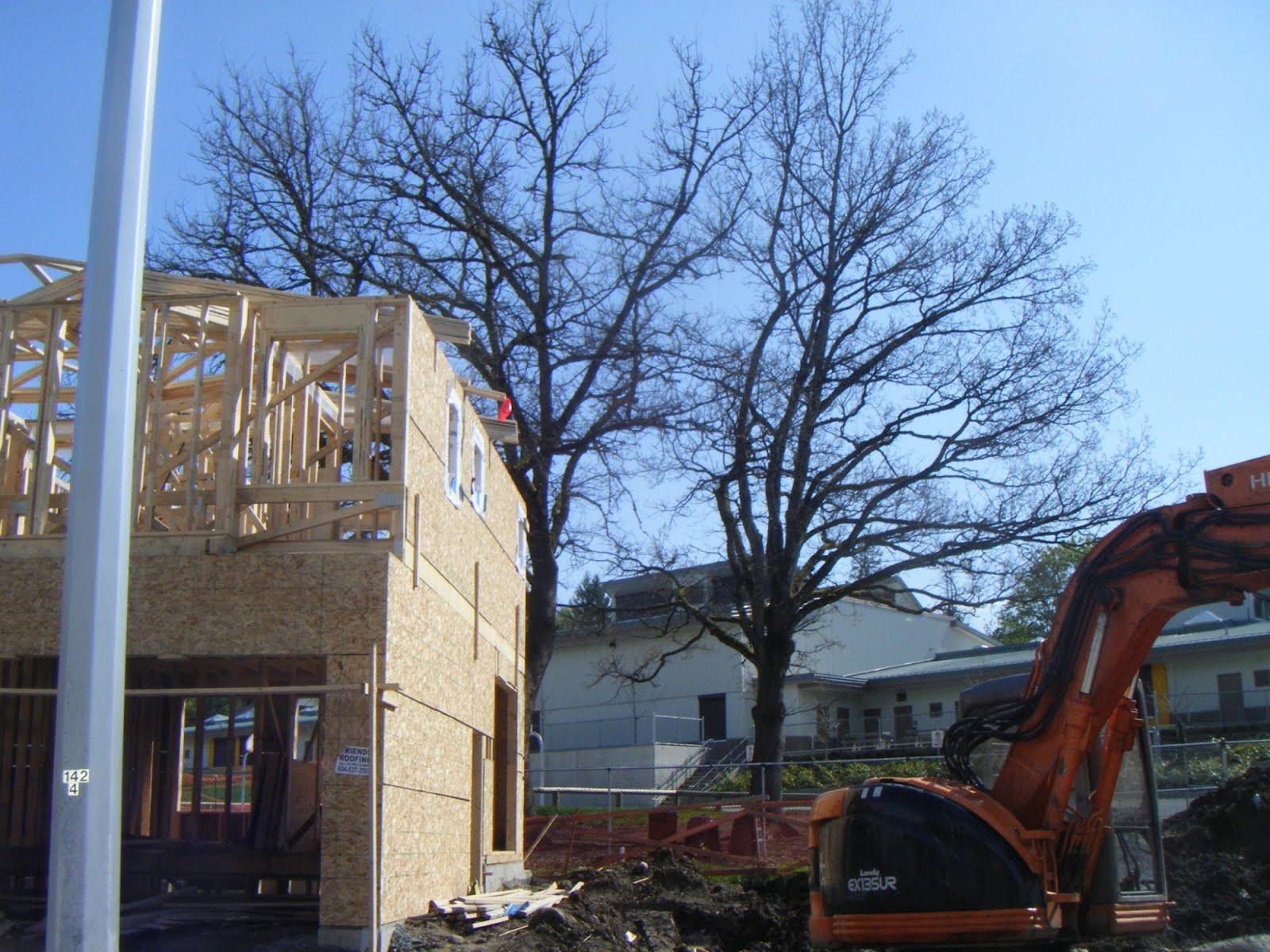
property supply pressures and value increases lead to homes being built closer together
The Consulting Arborist
Enter the consulting arborist. These guys and girls are not the same folks you hire to trim branches and run them through that noisy wood chipper. These arborists are professionals. They are experienced urban forestry experts that understand the needs of trees, builders and developers. Their role is to determine the most tree friendly plan, then to make sure that the plan is carried out. The consulting arborists job is ensure that the development satisfies the local government tree protection rules. They also have to balance their clients desires and make sure things are workable on the ground.
Tree Protection In Action
Step 1: Planning
At the design stage the arborist will inventory and assess all trees that could be affected. They will identify which trees can be saved and which cannot. They will work with the designer to come up with plans that best protect the trees.
Step 2: Implementation
To protect a tree on a work site is really about protecting roots. Each tree has an area of root mass that must remain untouched. This is called the ‘Critical Root Zone’ or the “Tree Protection Zone”. The larger the tree the larger the no go zone. 
neighbours trees must also be protected
Step 3: Special Considerations
During construction there may be times when the “Tree Protection Zone” needs to be worked on. This is the domain of the arborist. Details such as water lines, sewerage, gas and electrical need to be installed without causing root damage. Also driveways, retaining walls and landscaping require special planning, techniques and materials. Arborists work to find solutions to problems that in the past would have required tree removals.
Challenges to Tree Protection
The job is not easy. Many in the trades are used to the old ways. It is easier to build on a lot without trees. It takes commitment from all parties to make it happen. This includes the municipalities. They hold the most say over land development regulations.
Economic and demographic trends are a major consideration. As cities become more populated, land becomes more valuable. Houses get torn down and replaced with larger houses. Properties get subdivided into smaller lot sizes that leave less space for trees. The importance of tree protection increases as development increases. The job gets harder.
Neighbourhood politics and environmental realities often collide. Property owners have the right to develop their land within the rules. Emotions are stirred when history is lost. The old widow in the tiny bungalow passes on. Her house along with her well kept garden are razed for the installation of a mega home complete with tennis court and 4 car garage. Keeping pieces of the past becomes very important to the area residents. Mature trees, when healthy, remind us of the way things used to be. .
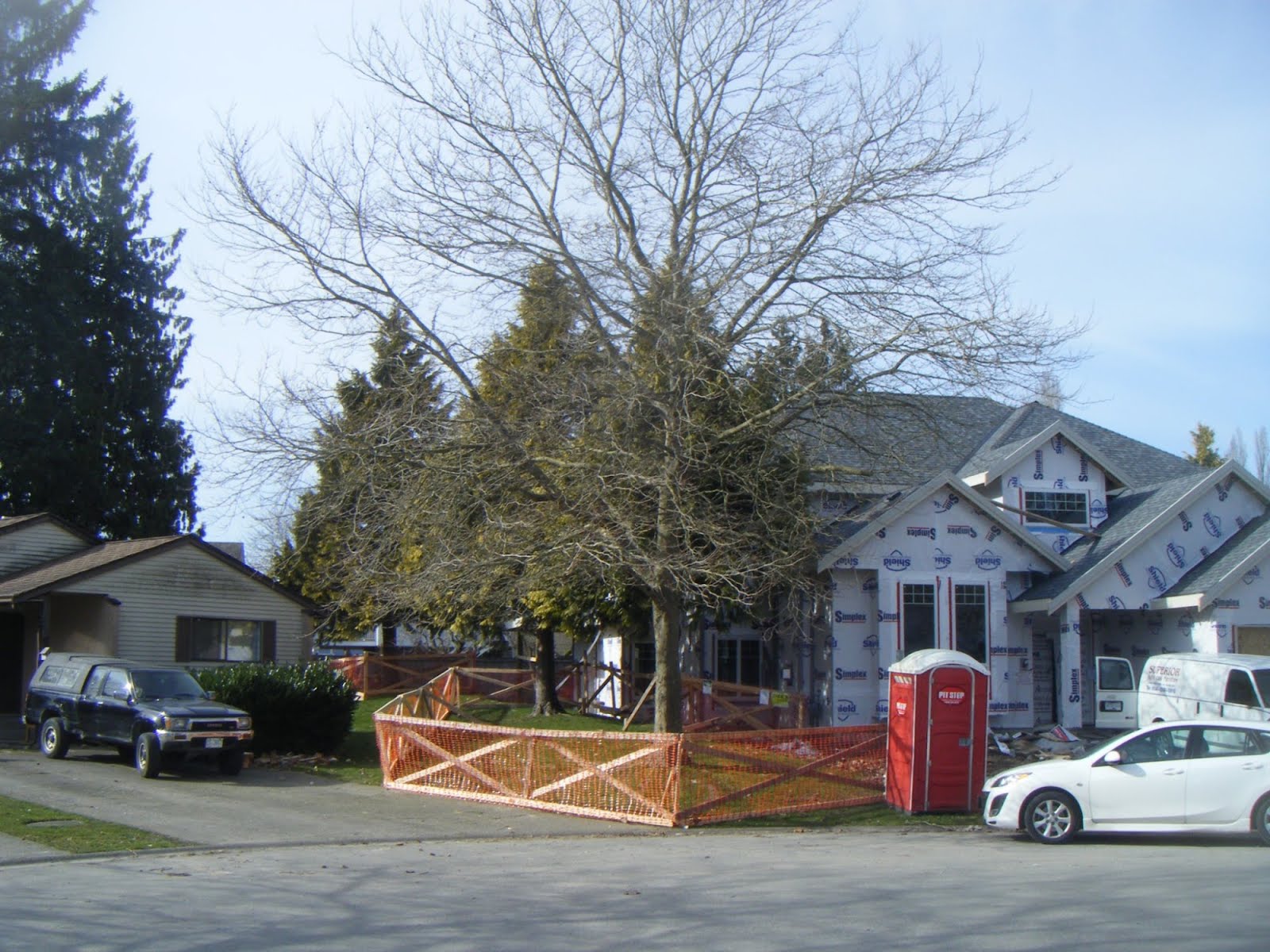
old neighbourhoods are transformed with new larger homes
Trees and Sustainable Development
Builders and developers take notice. Trees are more important than most people realize. Hire a consulting arborist, get them involved in the planning process. Implement a tree protection plan. Develop your land sustainably, earn your profits and be a good neighbour. Most of all respect the trees. Municipalities are in the drivers seat, the rest of us will hold them to it.
Terry Thrale is an International Society of Arboriculture certified Arborist. He is employed as an Urban Forester in the Planning and Development Department with The City of Surrey, British Columbia. He is also author of TreeReality.blogspot.ca .
Tuesday, 9 July 2013
The Secret to Getting a Tree Cutting Permit
I'm standing there in the front yard looking up at this thing.
It's two feet wide at the stump and about seventy feet tall. A Douglas Fir.
The guy starts telling me all the stuff he doesn't like about it.
I've worked with trees for a long time. My father was a logger and I followed in his footsteps. Since then I've done a lot of stuff with trees.
The things I have enjoyed the most about at this work is not the trees. It's the conquering of problems. Applying skill and creativity. It has been a career of working on some intense challenges. The things I love the most about working with trees are the tools that make it possible.
After a while I started noticing some problems out there in the realm of arboriculture. I put those problems into 3 categories.
There aren't many municipalities out there that even require a permit for cutting a private tree.
That's the real problem.
The secret I want to know is this.
It's two feet wide at the stump and about seventy feet tall. A Douglas Fir.
The guy starts telling me all the stuff he doesn't like about it.
moss on the roof
debris filled gutters
roots through the lawn
cracks in the cement
water line runs this way
gas line runs that way
sewerage goes there
daughters bedroom at the corner. She can't sleep at night cause she thinks it going to fall and crush her.
"Will you get rid of it for me?"I stopped to think about it.
Have you ever been upset to see a tree get cut that you felt should not have been cut?
I've worked with trees for a long time. My father was a logger and I followed in his footsteps. Since then I've done a lot of stuff with trees.
- fell
- planted
- climbed
- built
- pruned
The things I have enjoyed the most about at this work is not the trees. It's the conquering of problems. Applying skill and creativity. It has been a career of working on some intense challenges. The things I love the most about working with trees are the tools that make it possible.
After a while I started noticing some problems out there in the realm of arboriculture. I put those problems into 3 categories.
World is Falling Apart Problems
- Climate change
- Pine beetle
- Emerald ash borer
Industry Self Imposed Problems
- Unqualified, untrained contractors performing poor quality work at rock bottom prices.
General Public Lack of Understanding Problems
- A lot of people just don't understand trees.
What does all this have to do with the secret to getting a tree cutting permit?Here's the thing.
There aren't many municipalities out there that even require a permit for cutting a private tree.
That's the real problem.
The secret I want to know is this.
How do we get municipalities to do right by trees?
Saturday, 15 June 2013
List of Bad Stuff That Happens to Urban Trees
Trees in urban environments face many challenges. Here's a list that show some.
Conflict with Power Lines

This is a common site in most urban areas. Unfortunately for trees maintaining uninterrupted and safe electricity takes precendence over ANSI 300 pruning standards.
Stubbing of Branches

There are a lot of ways that untrained pruners damage trees. This is far too regular occurrence.
Raising the Grade

Perhaps less obvious to some is the fact that adding soil over the trunk and root area kills the tree. Though it may take a while to die.

Compaction during Construction

Even small machines cause future problems when working too close.
Lawn vs Young Tree

Tree loses
Concrete vs Young Tree

Tree loses
Misguided Pruning Saw vs Young Tree

Tree loses
Thursday, 13 June 2013
Climate Change and the Future of Urban Trees
Trees provide something unique to the conversation on climate change. They are one of the only things going that provide benefit in both an adaptive and a mitigation role.
I'm an arborist. In my job I study, photograph and make decisions about the future of trees everyday. In this piece I'll share some of what I see as it relates to the discussion on climate change. I will show things that often go wrong, and show that we just are not yet doing a good enough job of growing trees.


Here in the Pacific Northwest region our native conifers are dying rapidly. The deaths can be attributed to a number of contributing factors. Each of those factors seem to be made worse by climate change.


I'm an arborist. In my job I study, photograph and make decisions about the future of trees everyday. In this piece I'll share some of what I see as it relates to the discussion on climate change. I will show things that often go wrong, and show that we just are not yet doing a good enough job of growing trees.
Climate Change is Already Affecting Urban Trees
Here in the Pacific Northwest region our native conifers are dying rapidly. The deaths can be attributed to a number of contributing factors. Each of those factors seem to be made worse by climate change.
- Western Red Cedars are dying from top down.
- Douglas Fir become dry and susceptible to pest infestations causing death.
- Western Hemlock get overcome by fungal imbalances resulting in branch dieback, weakened stems, and rotting roots.
Boulevards of pretty pink blossoming trees in the Spring could become a memory of the past.
What will the future look like if we don't start doing a better job of growing, maintaining and preserving trees?
Responses to date have been meek. Governments are not addressing the issues. Industry is far too disorganized and has shown to be unable to make positive change. The public have yet to realize that there are problems here that should be addressed. Each entity contributes a response of no action, little action or action that contradicts what is being done in other jurisdictions.
Optimism
Despite all that is wrong in the world of urban trees I do find reason for optimism. The reason I say this is because trees are so simple to do right.
All you need is right tree, right place, add water and wait....
Wednesday, 24 April 2013
The 10 Rules of Trees
A healthy urban forest is possible.
It should be simple yet it is so uncommon.
Look beyond the reason why. Assume that what they tell us is true. Trees are more important than most people realize.
Yet there is a disconnect.
Urban forests are a mess.
How do you make people do right by trees?
It can be simple.
No need for a massive education campaign.
The industry already has the knowledge and equipment for the job.
We just need to have the rules in place and enforced.
It should be simple yet it is so uncommon.
Look beyond the reason why. Assume that what they tell us is true. Trees are more important than most people realize.
Yet there is a disconnect.
Urban forests are a mess.
How do you make people do right by trees?
- How do we stop people from cutting down trees that don't need to be cut.?
- How do you prevent someone from topping a tree?
- How do you prevent a neighbour from destroying a tree with bad pruning?
- How do we get enough new trees in the ground?
- How do we make sure that new trees are being properly planted?
- How do we make sure they get cared for until established?
It can be simple.
No need for a massive education campaign.
The industry already has the knowledge and equipment for the job.
We just need to have the rules in place and enforced.
The 10 Rules of Trees
#1 No tree should be cut unless it needs to be cut.
#2 For every tree cut down a new tree must be planted.
#3 Pruning is to be done properly or else not done at all.
#4 Plant them where they can become what they are meant to be.
#5 Respect the roots.
#6 Protect during construction.
#7 Speak to your neighbour before you act.
#8 When maintenance is required do it.
#9 Encourage children to climb.
#10 Life is hazardous. Trees fit into this category.
If you have questions about any of these rules ask an arborist.
Subscribe to:
Posts (Atom)